
Broadhead Steel, Edge Retention, and Why Material Choice Matters
Not all broadheads are created equal — and a lot of that difference comes down to what they're made of.
Steel grade, hardness, and heat treatment affect how a broadhead holds an edge, how it handles bone on impact, and whether it's worth sharpening and running again next season. These aren't marketing distinctions. They show up in the field, where the difference between quality steel and budget steel becomes impossible to miss.
What Steel Hardness Actually Means
Broadhead steel hardness is measured on the Rockwell scale — the HRC scale specifically. The number tells you how resistant the steel is to deformation under pressure.
Softer steel is easier and cheaper to manufacture, which is why it shows up in budget broadheads. The tradeoff is an edge that rolls or chips on bone contact and loses sharpness quickly. You might get one clean shot out of it, but resharpening becomes difficult or pointless because the steel won't hold a fine edge.
Harder steel holds its geometry through impact. The edge stays sharper longer, resists deformation when it hits bone, and can be resharpened repeatedly to a consistent, hunting-ready finish. The tradeoff is that it requires more precise machining to work with — which is part of why quality costs more upfront and pays off over time.
The Two Steels VPA Uses — and Why
VPA broadheads are built from one of two steel grades depending on what the head is designed to do.
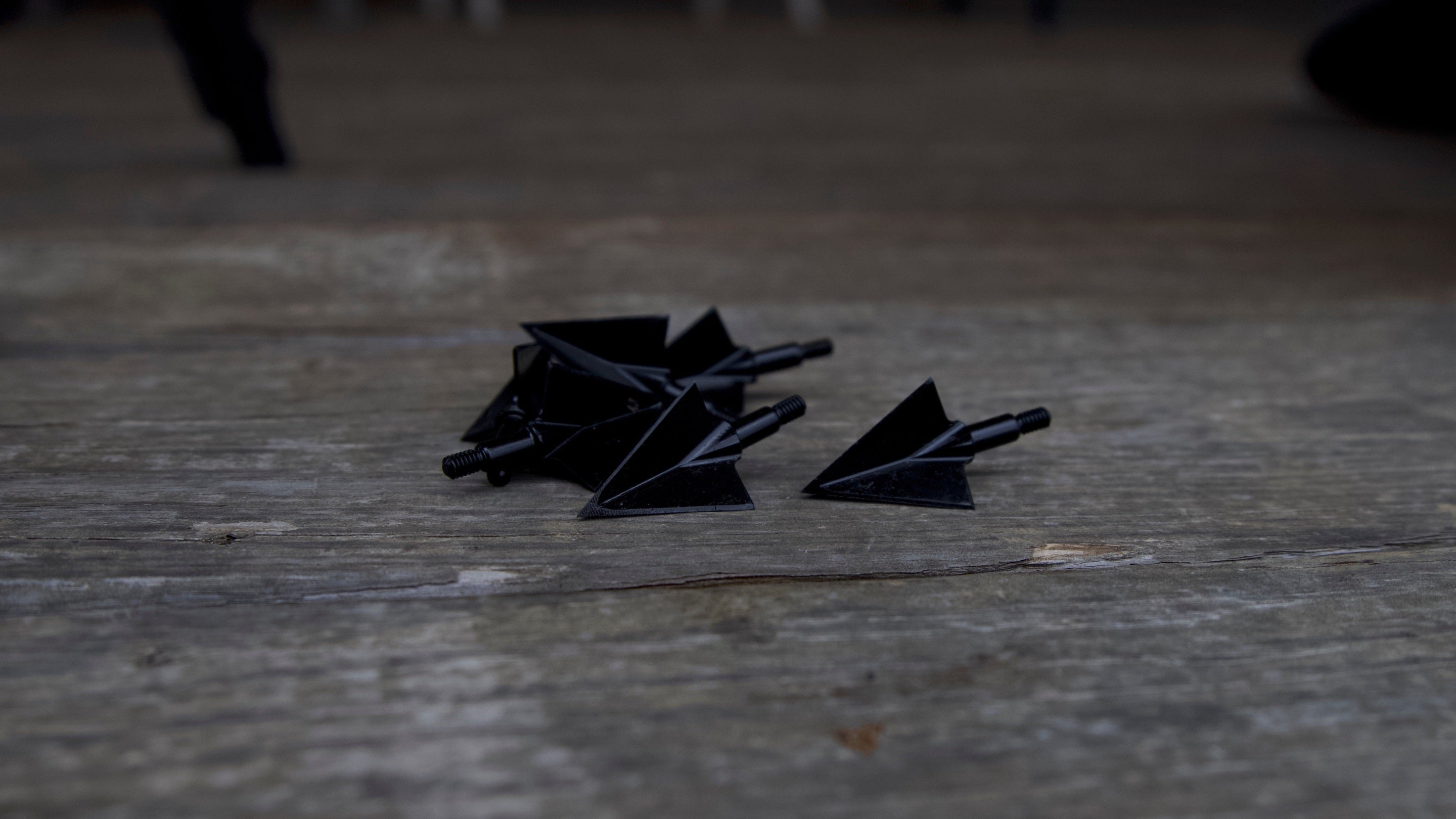
1045 carbon tool steel is used in VPA's 3-blade and 2-blade double bevel heads. It's a proven, tough carbon steel with good edge characteristics and the strength to handle the demands of fixed-blade hunting. It machines cleanly, holds an edge well, and can be resharpened and reused across seasons. For hunters who want a reliable, durable fixed blade at a strong value, 1045 is a legitimate choice that outperforms the mild steel found in most budget broadheads.
S7 tool steel is used in VPA's Omega and premium single bevel heads. S7 is a shock-resistant tool steel — the same category of material used in industrial punches, chisels, and cutting tools that take repeated high-impact loads without fracturing or deforming. It combines high hardness with exceptional toughness, which is a combination that's difficult to achieve and exactly what a broadhead needs. Hard enough to hold a razor edge. Tough enough to drive through bone without failing.
The choice of S7 for the Omega and single bevels isn't arbitrary. These heads are designed for maximum penetration on heavy-boned game — the kind of hunting where a broadhead contacts bone not as an accident but as part of the expected shot. S7 is built for that.

Edge Retention Under Real Hunting Conditions
A broadhead that arrives sharp isn't the whole story. What matters is how it performs after impact.
When a broadhead contacts bone — a shoulder blade, a scapula, a rib at an unexpected angle — the steel takes significant stress at the edge. Lower-quality steel deforms. The edge rolls, the tip bends, and the head loses its cutting geometry mid-penetration. That's when recoveries get difficult.
Higher-quality steel maintains its geometry through that stress. The blade keeps cutting, and the arrow continues driving forward. Penetration improves not because the broadhead is designed differently, but because the material can handle the load.
This matters most for elk, bear, or any heavy-boned animal where angled shots and unexpected contact are part of the reality — and where a head that fails mid-penetration has real consequences.
Why Material Quality Determines Reusability
The economics of quality broadheads only make sense over time.
A budget head that bends, chips, or can't be resharpened after one shot isn't actually cheaper — it's a delayed cost. Add up what you spend replacing heads over a few seasons and the math becomes obvious.
A broadhead machined from quality steel, properly maintained, can be resharpened and put back in the quiver repeatedly. The edge comes back cleanly, the structural integrity stays intact, and the head performs the same on its fifth use as it did on its first.
This is the model VPA was built around. Not a head you shoot once and throw away. A head you shoot, resharpen, and trust again — season after season.
One-Piece Construction and What It Has to Do With Steel
Material choice matters even more when the broadhead is machined from a single piece of steel.
Multi-piece broadheads — welded ferrules, inserted blades, press-fit components — have failure points that no amount of good steel can fully eliminate. The joint is always the weak spot.
One-piece machined construction removes those failure points entirely. The head is only as strong as the steel it's made from, which means the steel has to be worth trusting. With 1045 or S7 tool steel and tight machining tolerances, that's exactly what you get: no welds, no inserts, no weak points — just a single piece of material built to hold up when it matters.
The Bottom Line
When you're at full draw and everything is on the line, the last thing you want to be wondering is whether your broadhead is going to hold up.
Material choice is how you stop wondering.
1045 carbon tool steel for proven, season-after-season durability. S7 tool steel for maximum toughness on heavy-boned game. Both machined in-house in Fort Wayne, Indiana, from a single piece of steel — no welds, no weak points, backed for life.
That's not a premium feature. That's the baseline for gear worth carrying.


Leave a comment