Single Bevel vs. Multi-Blade Broadheads: What's the Difference?
Every fall the same question comes up at the range and in our inbox: single bevel or multi-blade? Both designs kill game cleanly when the shot is right. The real difference is how each one behaves when it meets bone, and how well it matches the bow and arrow you're actually shooting.
Here's how they compare, and how to pick the right one for your setup.

What a single bevel broadhead does
A single bevel blade is sharpened on one side only, like a chisel. As the head moves through tissue, that angled edge pushes against the material and turns the broadhead. The result is rotation inside the animal.
That rotation matters most at bone. Instead of glancing off, a single bevel tends to split bone as it turns and keep driving forward. That's why single bevels are a common choice for big-bodied game, steep or quartering angles, and hunters running heavier arrows.
- Strengths: splits bone instead of skipping off it, strong penetration on heavy-boned game, durable blade geometry.
- Tradeoffs: setup takes a little more attention (your bevel direction should match your fletching), most single bevels need a jig to hold the bevel angle when you sharpen, and two blades means less total cutting surface than a 3-blade of the same diameter.
What a multi-blade broadhead does
Multi-blade heads, most commonly 3-blades, are sharpened on both sides of each blade and cut in a straight line. Three cutting edges means more tissue cut for a given diameter, which opens a wide wound channel and helps put down a good blood trail on a well-placed shot.
- Strengths: more cutting surface, a wide wound channel, and they fly well out of a wide range of setups.
- Tradeoffs: more blade surface means more resistance, so lighter arrows give up some penetration. And a 3-blade cuts straight through bone rather than rotating to split it.
Side by side
| Single Bevel | Multi-Blade (3-Blade) | |
|---|---|---|
| Cutting action | Rotates through tissue and splits bone | Cuts straight with more cutting surface |
| Where it shines | Heavy bone, big-bodied game, tough angles | Broadside shots, maximum tissue damage |
| Arrow setup | Best with heavier arrows and good FOC | Performs across a wide range of setups |
| Fletching | Match helical direction to the bevel | Any fletching that flies it true |
| Sharpening | Standard single bevels sharpen with a jig; the VPA Omega lays flat (LAYFLAT™), no jig | VPA 3-blades lay flat on a stone |
How to choose for your setup
1. What you're hunting. On whitetail with a well-tuned setup, either design gets the job done. For elk, hogs, moose and other heavy-boned game, the bone-splitting rotation of a single bevel is a real advantage.
2. Your arrow weight. Single bevels perform best with enough arrow behind them. If you're running a heavier arrow with good front-of-center weight, a single bevel makes the most of it. Lighter, faster setups often fly and perform very well with a 3-blade. Our guide to broadhead weight for deer vs. elk goes deeper on matching grain weight to your setup.
3. The shots you get. If you hunt country where the angles aren't always perfect, like steep western terrain or tight timber, a head built to handle bone gives you more margin.
4. Your tuning. With a single bevel, match the bevel to your fletching: right bevel with right helical, left bevel with left helical. With any fixed blade, spin-test your arrows and confirm your broadheads hit with your field points before season. An arrow spinner makes that quick.
Where the VPA lineup fits
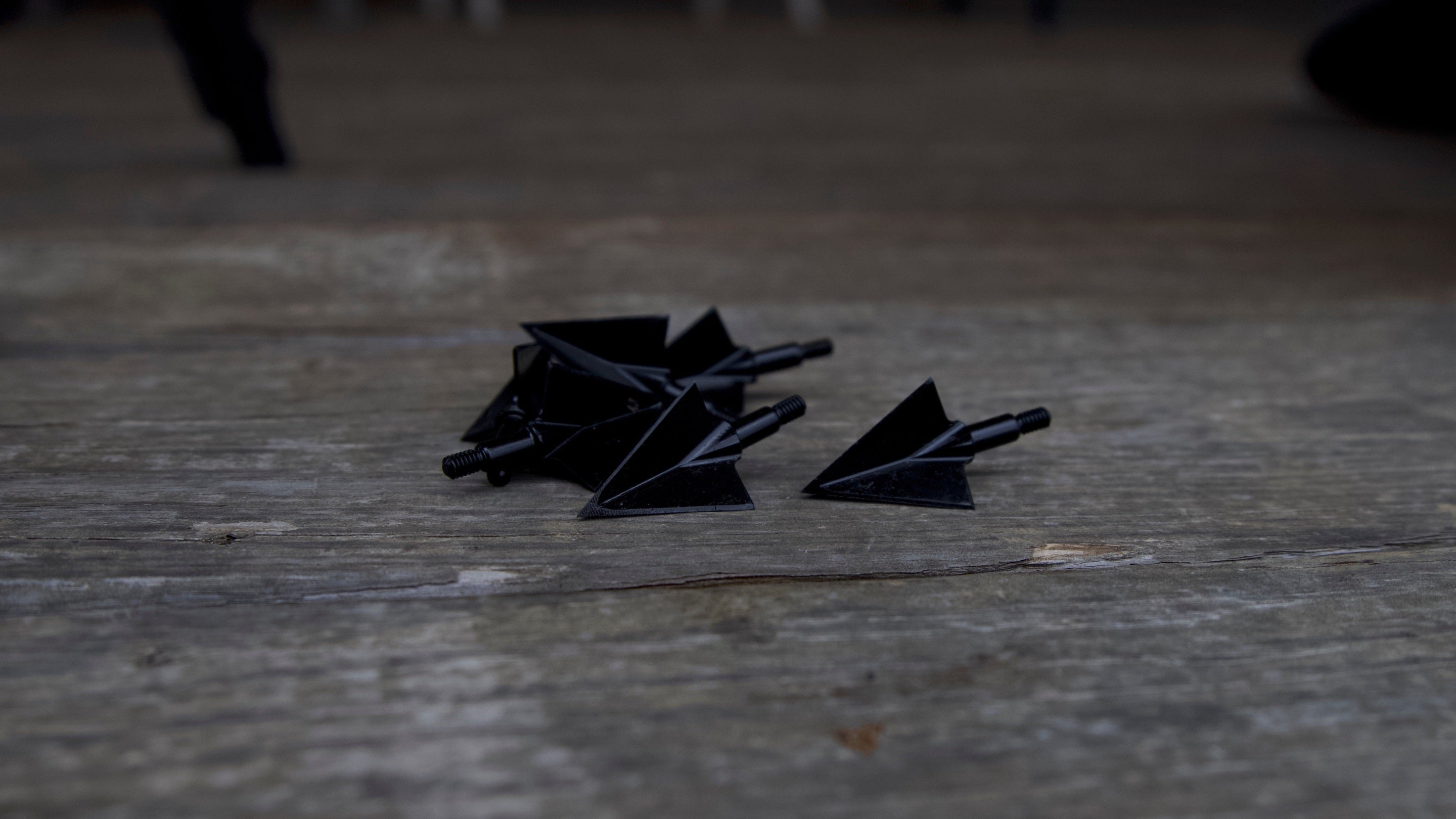
- Omega (U.S. Patent No. D1,086,354 S): a hybrid design. A 40° offset double bevel at the front transitions into a 26° single bevel, so it starts rotation while keeping the strength of a one-piece blade and ferrule. S7 tool steel at 56–58 Rockwell, with LAYFLAT™ sharpening: lay it flat on a stone and push. No jig, which makes it the easiest single bevel in our lineup to keep sharp, even from the stand. Also available with Bleeders for a wider wound channel.
- 2-Blade Single Bevel: a 35° bevel with straight blade geometry for penetration and strength. Available in S7 or 1045 tool steel, 125–250 grain. Sharpen with a jig to hold the bevel angle; our Broadhead Sharpener with the Spacer Block is set up for it.
- 3-Blade: one of our best sellers. One-piece construction with a chisel tip that cuts on contact, available from 100 to 300 grain.
- AC Hole Punch (Patent Pending): a fixed-blade design with six cutting surfaces, built for a big wound channel.
- 2-Blade Double Bevel: the "Penetrator." A simple two-blade head built to drive through bone and dense tissue, and a good middle ground if you want penetration without the bevel-matching.
- Omega Ascender (Crossbow) (U.S. Patent No. 12,638,278 B1; Integrated Outsert System Patent Pending): a right-hand single bevel built in one piece for .300 ID / .350 OD bolts.
Every one is CNC-machined from a single piece of steel in Fort Wayne, Indiana. No welds, no replaceable blades, and every one is built to be resharpened and hunted again.
Still not sure? Shoot both.
The best answer comes from your own bow. Put a single bevel and a 3-blade through your setup, check how each one flies, and go with the head you trust most. Our Custom Test Pack is an easy way to try different VPA heads before committing to a full pack (Omega heads not included).
Whichever you choose: tune it, sharpen it, and put it where it counts.
Related reading
- Fixed Blade vs. Mechanical Broadheads: Which Is Best for Bowhunting?
- Broadhead Steel, Edge Retention, and Why Material Choice Matters
Patent and trademark information: vparchery.com/pages/ip


Leave a comment